
Establishing a Vibration Baseline on a Sullair Rotary Screw Compressor
Industry: Industrial Manufacturing
Equipment: Sullair Enclosed Rotary Screw Compressor
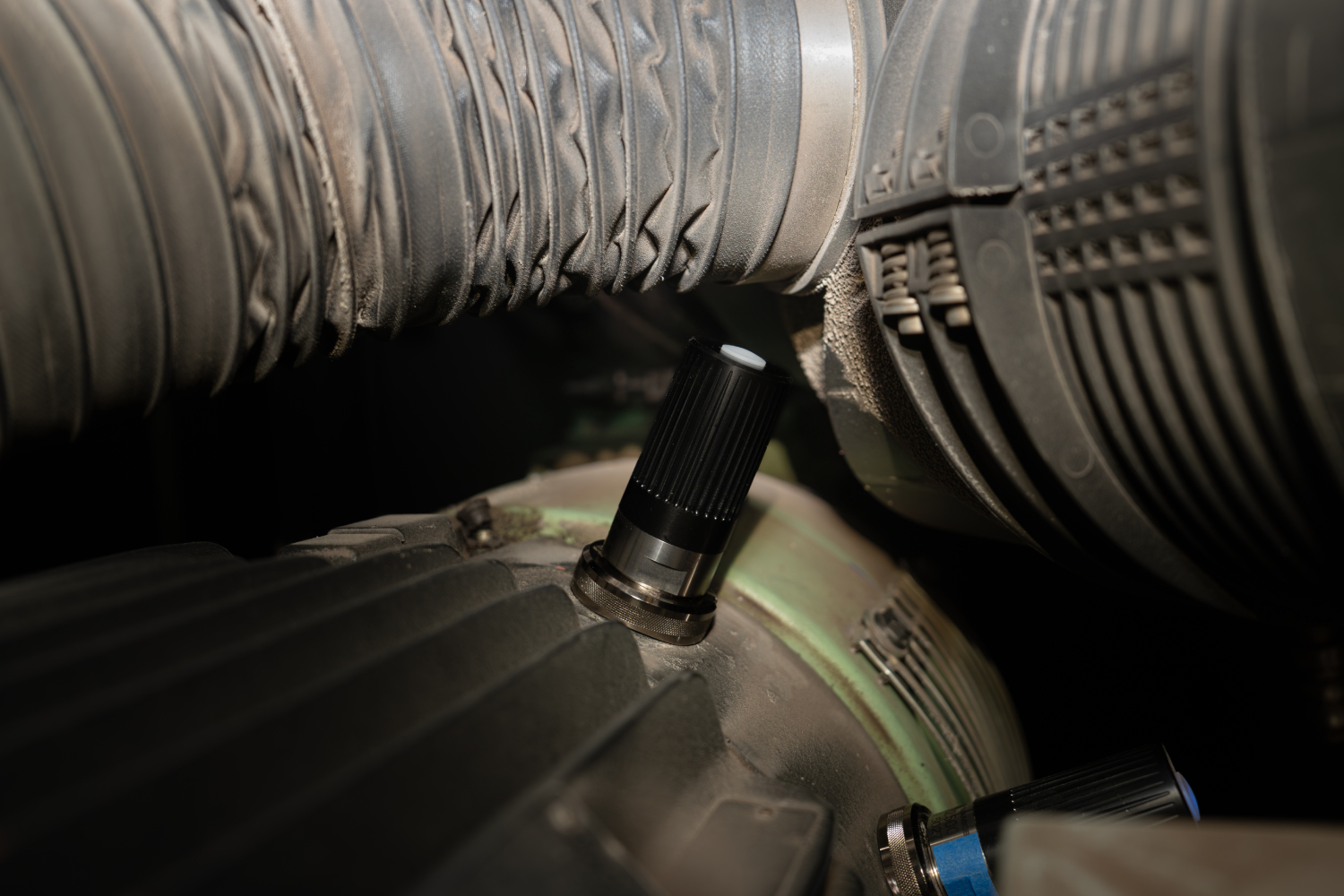
Monitoring Tool: QI2500 Vibration & Temperature Sensor
The Challenge
Compressed air is one of the most critical utilities in a manufacturing facility. When a compressor goes down unexpectedly, production stops — sometimes instantly.
The customer wanted to:
- Establish a vibration baseline
- Understand the mechanical condition of the compressor
- Detect potential problems early
- Avoid subscription-based monitoring systems
- Maintain control of their own data
They requested a complementary on-site assessment using the QI2500 vibration sensor.
The Equipment
The system evaluated was a Sullair rotary screw compressor with:
- 3-phase TEFC motor
- 60 Hz operation
- Approximate running speed: 1775 RPM
- Enclosed cabinet design
Two locations were tested:
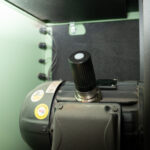
- Main motor – Drive End
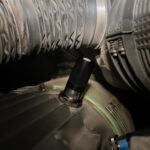
- Compressor pump section
Sensor sample rate: 8000 Hz
The Baseline Measurements
Motor – Drive End
| Metric | Result |
| Velocity RMS | 5.68 mm/s |
| Dominant Frequency | 29 Hz |
| Acceleration RMS | 6.25 m/s² |
| Crest Factor | 4.73 |
| Temperature | 70.9 °F |
Interpretation:
- Dominant frequency matched running speed (~1775 RPM ≈ 29.6 Hz)
- Vibration was primarily steady-state mechanical motion
- Overall vibration level was elevated for a motor of this size
- No high-frequency bearing failure signature detected
Compressor Pump Section
| Metric | Result |
| Velocity RMS | 7.65 mm/s |
| Dominant Frequency | 15 Hz |
| Acceleration RMS | 6.94 m/s² |
| Crest Factor | 3.83 |
| Temperature | 70.2 °F |
Interpretation:
- Higher overall vibration than the motor
- Dominant frequency consistent with internal mechanical components
- Vibration primarily steady-state rather than impact-driven
- No immediate failure indicators
What the Data Revealed
This compressor is operating, but not in a low-vibration condition.
Key observations:
- Motor vibration is elevated.
- Pump vibration is high enough to warrant monitoring.
- No signs of catastrophic bearing failure.
- No abnormal temperature rise.
- Machine likely experiencing:
- Minor imbalance
- Alignment deviation
- Internal rotor wear
- Structural amplification inside enclosure
This is exactly the stage where predictive monitoring delivers value.
Why Baselines Matter
Without a baseline, maintenance teams only react after symptoms escalate.
With a baseline:
- Changes can be detected early.
- Trending reveals deterioration before failure.
- Maintenance can be planned.
- Downtime becomes predictable instead of sudden.
This visit established a reference condition for both the motor and pump.
Future readings will now be compared against these values — not generic industry charts.
Suggested Monitoring Thresholds
Based on the baseline:
Motor
- Yellow: 6.5 mm/s
- Red: 8.0 mm/s
Pump
- Yellow: 8.5 mm/s
- Red: 10 mm/s
More important than absolute numbers is change over time.
A sustained 15% increase from baseline should trigger inspection.
The Business Impact
A rotary screw compressor failure can result in:
- Production stoppage
- Overtime labor
- Emergency service costs
- Expedited parts
- Secondary equipment stress
By establishing a baseline and trending monthly:
- Problems are caught early
- Repairs are scheduled
- Unexpected downtime is reduced
- Maintenance budgets become more predictable
All without subscriptions, cloud dependence, or IT involvement.
Why the QI2500 Was Used
The QI2500 allowed:
- Rapid deployment
- 8000 Hz high-resolution sampling
- Direct data download to phone or PC
- No recurring fees
- Full customer ownership of data
This approach fits facilities that want real predictive insight — without committing to enterprise-level monitoring platforms.
Final Assessment
This compressor is stable but operating with elevated vibration.
There is no immediate failure risk.
However, this machine is not running in an optimal mechanical condition.
It is an ideal candidate for ongoing vibration trending.
This case demonstrates the value of:
- Establishing a baseline
- Monitoring trend direction
- Intervening before breakdown
- Keeping maintenance proactive instead of reactive
Takeaway
You don’t need a cloud subscription or a complex monitoring system to protect critical equipment.
You need:
- A reliable baseline
- Simple, accurate measurements
- Consistent trending
That’s it.
Case Study