
How a Simple Baseline Revealed Hidden Risk in a Rotary Screw Compressor
Industry: Industrial Manufacturing
Equipment: Sullair Rotary Screw Compressor
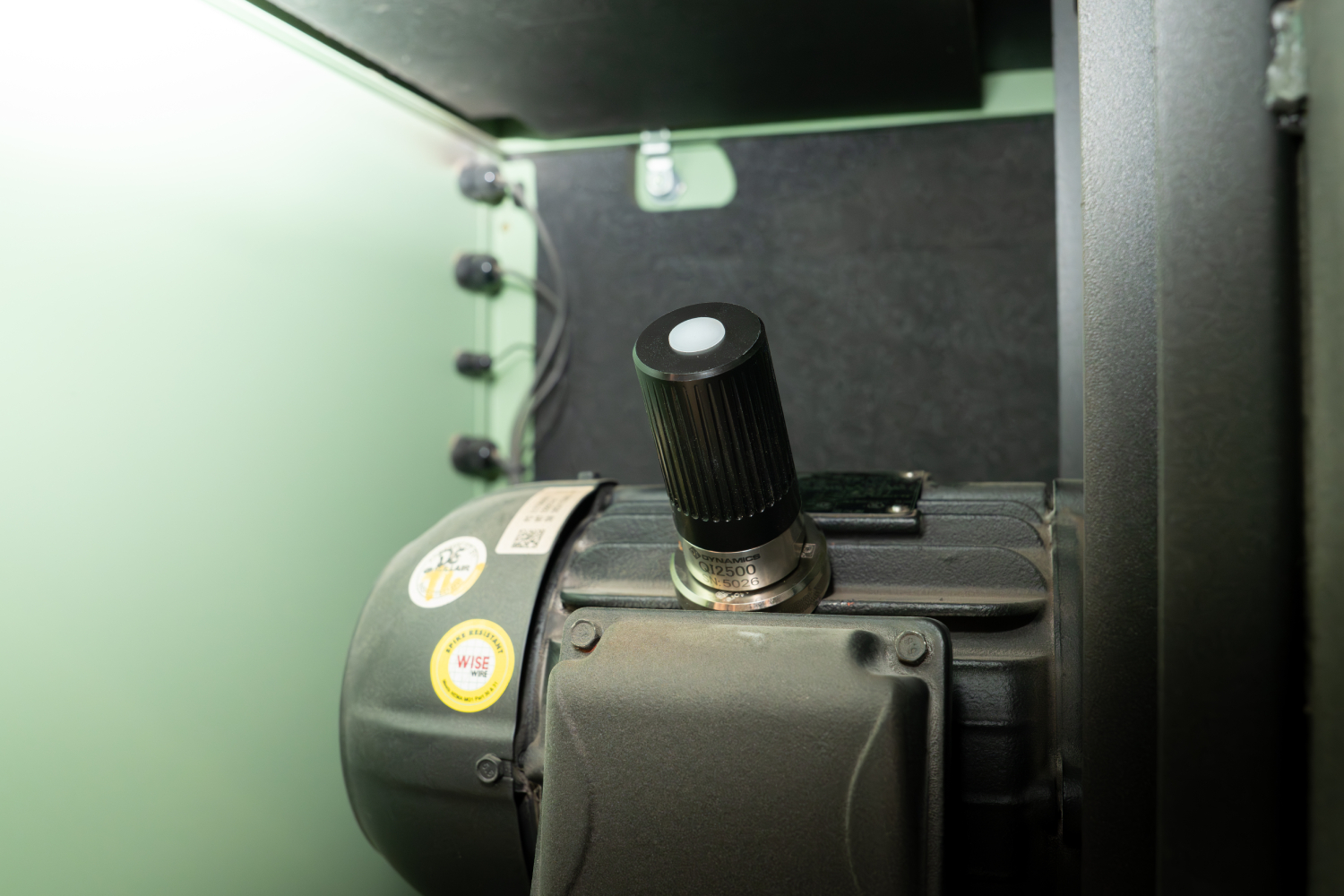
Monitoring Tool: QI2500 Vibration & Temperature Sensor
The Situation
Compressed air is often the single most critical utility in a plant.
When a compressor fails unexpectedly, production doesn’t slow down — it stops.
A manufacturing facility asked for a simple question to be answered:
“Is our compressor running healthy… or are we just hoping it is?”
They did not want:
- A subscription
- A cloud contract
- IT involvement
- A complicated monitoring system
They wanted clarity.
The Approach
We installed a QI2500 sensor and collected baseline vibration data from two locations:
- Motor – Drive End
- Compressor Pump Section
Sampling rate: 8000 Hz
Data collection time: 1 minute per location
No wiring.
No configuration headaches.
No recurring fees.
What the Data Showed
Motor – Drive End
- Velocity RMS: 5.68 mm/s
- Dominant Frequency: 29 Hz (matches 1775 RPM running speed)
- Temperature: Normal
The motor is operating steadily, but vibration is elevated above what would be considered ideal for long-term operation.
Compressor Pump
- Velocity RMS: 7.65 mm/s
- Dominant Frequency: 15 Hz
- Temperature: Normal
The pump section showed higher vibration than the motor.
There were no signs of catastrophic bearing failure — but the machine is not operating in a low-vibration condition.
Why This Matters
Nothing was “broken.”
But this compressor is operating closer to the edge than most maintenance teams realize.
This is exactly how failures develop:
- Slight imbalance
- Minor alignment drift
- Gradual internal wear
- Structural amplification
Not dramatic.
Not obvious.
But slowly progressing.
Without a baseline, these changes go unnoticed.
The Value of a Baseline
Now this facility has:
- A documented vibration reference point
- Suggested yellow and red thresholds
- A measurable starting condition
- A way to detect change early
The next reading will not be compared to a chart in a textbook.
It will be compared to their machine.
That’s real predictive maintenance.
The Practical Reality
Many monitoring systems require:
- Annual software contracts
- Cloud subscriptions
- IT approval
- Integration projects
- Ongoing licensing costs
This baseline was established with a single sensor.
The data was downloaded directly.
The facility owns the data.
Forever.
Why This Matters Financially
A compressor failure can mean:
- Lost production
- Emergency service calls
- Expedited parts
- Overtime labor
- Secondary equipment stress
One avoided failure easily exceeds the cost of monitoring.
And the cost to monitor?
$695. One time.
No subscription.
No renewals.
No cloud dependency.
Final Assessment
The compressor is stable — but not optimal.
It doesn’t need panic.
It needs monitoring.
This is exactly the stage where proactive maintenance saves money.
If You’re Reading This…
If you have a compressor, motor, pump, gearbox, or fan that you “assume is fine” — you don’t need a platform rollout.
You need a baseline.
The QI2500 gives you:
- High-resolution vibration data
- Temperature tracking
- Simple data download
- Full ownership
- No recurring fees
And it costs less than most emergency service calls.
Establish your baseline.
Know before it breaks.
QI2500 Vibration & Temperature Sensor – $695
Own the sensor.
Own the data.
Protect your equipment.
Case Study